Posts mit dem Label Melissa werden angezeigt. Alle Posts anzeigen

Donnerstag, 29. Mai 2014

How do instant photographs work?

In order to answer the question of how exactly Polaroid cameras are able to take pictures and have them fully developed only moments later, some information on the structure of the film used in instant cameras is needed.
The Polaroid film itself consists of the same three light-sensitive layers used in conventional cameras, which are separated from each other by dye coupler layers. An image layer, along with a timing layer and an acid layer are placed on top of them. A black base layer forms the undermost layer of all of the other layers mentioned above. Probably the most important layer is the layer situated between the light-sensitive layer and the image layer, which contains a chemical called the re-agent. 
The re-agent is a mixture of opacifiers, which block light; alkali, necessary for neutralizing acids; and white pigments. The entire frame of the film is covered in a combination of these elements. The re-agent itself starts the chemical reaction taking place in Polaroid film.

The chemical processes start once the Polaroid camera pushes the film out, using rollers inside the camera. The re-agent is spread across the whole film, which starts a series of chemical reactions. The colors from the dye layers move up from the lower layers, the acid layer moves towards the top and the re-agent moves towards the lower layers. Another chemical reaction occurs once the re-agent and the acids meet. The alkali and the opacifier in the re-agent react with the acids to make the re-agent turn clear. Following this reaction the image starts to appear until the film is, at last, fully developed.

Samstag, 10. Mai 2014

Group/Instructional: How to build a camera lucida

Rating the instructions of ‘How to make a camera lucida'

Though the instructions on “how to make a camera lucida” are not completely useless, there are several aspects of the instruction that could be improved. One of the aspects that proves that the instructions are insufficient is the fact that they rely heavily on the use of images. In fact, they rely on pictures to the point that the instructions become incomprehensible once they are removed from the text.

The text that accompanies the images does not give any precise instructions and is, for several reasons, confusing. One of those reasons is that it lacks a clear chronological order. This can confuse those people who have never seen or constructed a camera lucida before and therefore do not know about the logical order of the steps taken to build one.

Another problem is that no hints or warnings are mentioned, which could prevent accidents and ensure a successful construction of the camera lucida. Just as serious as the lack of hints and warnings, is the fact that it does not include a list of what materials should be used. Many readers might, for example, choose a piece of clear plastic unfit for the use in a camera lucida and therefore not achieve the expected outcome.

The fact that the title does not even hint at the fact that the text includes both, the instructions on how to build a camera lucida, but also how to use it, could lead to more misunderstandings. Equally, the text should be divided into separate parts for the construction of a camera lucida and its use for drawing.

If the text were to be adjusted in the points mentioned above, the instructions could easily be rendered comprehensible and useful to its readers.

Samstag, 12. April 2014

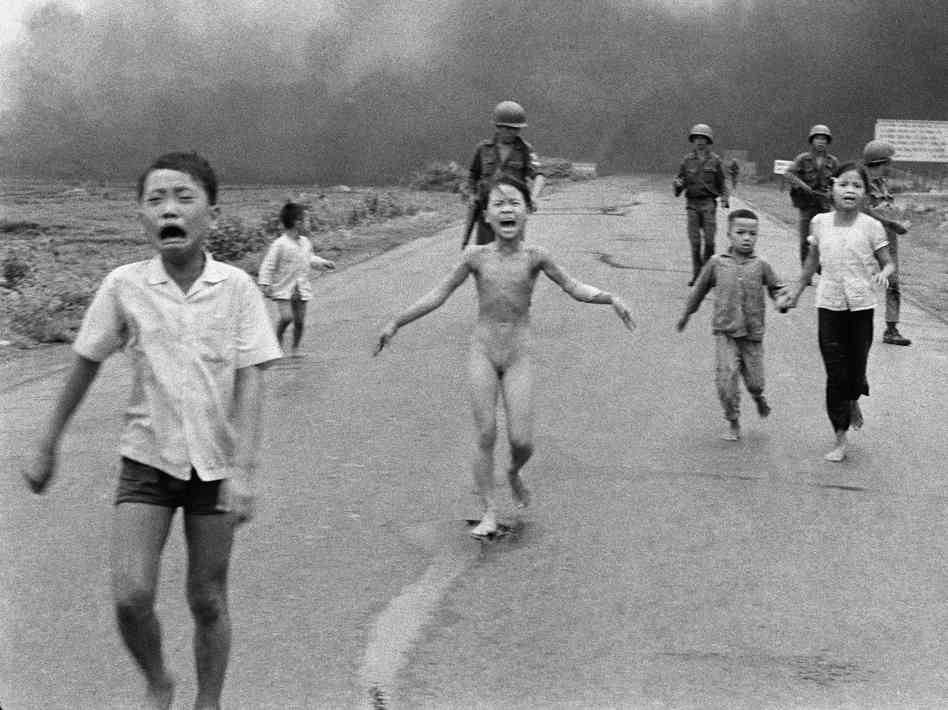
Napalm Girl Descriptive Paragraph

http://media.npr.org/assets/img/2012/06/03/napalm-girl-88f02cbaad205d1edf5f19e683c39e6cb4df9c3c-s6-c30.jpg

In this black-and-white photograph, five children can be seen running on a street towards the viewer of the photograph. All of them look quite malnourished and seem to be fleeing from something. The boy in the foreground on the left side of the picture has his eyes closed and his mouth wide open in a look of despair and immense fear. The girl in the middle of the picture is naked, running away with an expression of fear and distress on her face. A young boy and girl, following her on the right side of the picture, are holding hands as they run. The smallest of the children is following behind on the left side, slightly turning back towards the four soldiers following them. Unlike the children, the soldiers, who are loosely holding their guns, look fairly relaxed. Empty fields spread to each side of the slightly wet road and the thick smoke in the background covers the sky.

Kristina, Sandra, Markus

Donnerstag, 3. April 2014

History of Photography - Narrative

Version 1:The story of my life, the story of photography
There are dozens of people, dressed completely in black, who are watching me carefully. As soon as the coffin leaves the house, the descendants and acquaintances of my former owner start to discuss which of her many artistic possessions, meaning us, should now belong to whom. Had I been able to, I would probably have laughed in this situation for this is not the first or second time I am going to change owners and each and every time the same situation repeats itself. My constant change in owners, however, is only normal, as I was created in 1844. I can proudly say that I am the 170-year-old Daguerrotype of Louis Daguerre himself.
There are very few people in this world who know that the process needed for creating a Daguerrotype such as me is long and difficult. Photographs like me are taken through exposure of iodized silver plates to light. Those plates are insensitive to light, which leads to a long exposure time, and extremely expensive.  The worth of one plate is as much as that of fine jewellery. So back when I was created I was one of the most expensive possessions of my owner.
While people used to admire photographs such as me, they were also quite fearful of us, suspecting that the faces that resembled them so much could be watching them. Sadly, however, my whole life went through a change the day people realized that they could retouch negatives. Suddenly the mirrored image of their faces was not enough for them anymore, they wanted perfection. If their hair was not completely straight in a photograph they could just edit it later on. This, however, was not the worst of the inventions of photography that was yet to come. Clients even started to request reproductions of their photographs, created by a process that they called “mezzotint”. This process robbed images of their uniqueness and their famous “halo”, which gave our photographs that certain aura of prestige.
Though I am now worth several thousands of euros, the decline in taste when it comes to photography has deeply wounded me. People now make weird V-poses in front of these cameras that are apparently digital and can send them to everybody online. The fact that photographs like me remain though, has led to the revival of old photographs with hundreds of photographers trying to revive style of photography through which we were taken.

Feedback:My peers generally liked my text but mentioned that they could not find a conflict or goal in my story. They also mentioned that I used too much information and therefore did not concentrate enough on the narrative style of my story. So the advised me to use a bit less information and concentrate ind telling the photograph's story instead.

Final Version: The struggles in life of a 170-year-old Daguerrotype
As the first rays of light fall through the dusty windows, dozens of people, dressed completely in black, enter the tiny room and flock around the numerous pictures on the walls. Dust has settled on most photographs’ ebony frames. As soon as everybody has settled around the coffin, located in the middle of this stuffy room, the minute’s silence begins. Soon the silence is broken by quarrelling about who should inherit the many artistic possessions of my former owner. I watch the dispute with the inherent pride of a 170-year old Daguerrotype photograph. That is what I am: An original photograph of Daguerre himself, taken in 1844. Throughout the centuries I have changed owners many times and there is, as always, a single question on my mind: how will my new owner treat me?


My first owner, Daguerre, was the proud inventor of the camera obscura, the precursor of these tiny digital cameras the youth uses nowadays. Of course, when the first camera was invented, having your photo taken was an extremely long and expensive process. Back then iodized silver plates were used to create photographs, a single one of them worth as much as a fine piece of jewellery. Only the elite of society could therefore afford to have their photos taken. Those plates were also insensitive to light, leading to long exposure times. Daguerre therefore treated me with the utmost respect; handling me as though I was the most precious possession in his household, which I probably was.


I was later handed down to his ancestors and had to experience the decrease of prestige in photography. People started to leave their house when they had their pictures taken, returning with images that showed them with weird props in the background, which marked the beginning of studio photography. Worse, people had learned to reproduce photographs with a process called mezzotint, which led to the loss of the halo in photographs, an effect created by long exposure times. People had soon learned, however, to recreate this effect by using the gum print. Consequently, my worth decreased and each following owner handled me with less care.

My train of thought is interrupted by a hand grabbing me. “Mum, I want this one. This one is prettier than all the rest”. I want to smile. My life suddenly seems to go through a change once again.

Freitag, 14. März 2014

A day in the life of a humble….me

At 7 o’clock in the morning the penetrating ring of the alarm throws me out of my bed in a state of shock. 7 o’clock, that’s the usual time for me to throw back my covers and crawl out of bed in order to prepare for morning classes at the Department for Translation Studies. I skip breakfast, on most days at least, and get on my bike so as not to be late for my 8:15 class. I sit through several courses and fight to stay awake through most of them. During my break I try to catch up on some homework or go to Billa to fetch a quick snack before my next class starts. I come home in the evening, exhausted from a day spent studying. 

As soon as I open the door, however, I feel the exhaustion fade away, simply by looking at my flatmates, who are luckily also my best friends. We often cook together in order to save money and time. While eating, we catch up on the latest news in our lives, most of them directly related to our university lives. At midnight I go to sleep, waiting for what is going to happen the next day at ITAT.


Samstag, 18. Januar 2014

Final Version: Will Iceland join the EU?

Draft: Will Iceland join the EU?


Ever since the Icelandic coalition government first presented its application for EU membership in 2009, there has been an ongoing debate of whether Iceland should join the EU or not. The question of membership of the European Union (EU) has been a constantly discussed topic in Reykjavík and in Brussels since the Icelandic coalition government first presented its application in July 2009. Throughout the next three years, the accession criteria were permanently discussed. Unlike some other potential members Iceland fulfills the EU’s political and economic criteria. Additionally, it is already a member of the Schengen zone, the European Economic Area (EEA), and has a long standing democracy whose parliament dates back to the year 930. However, the new elected government of Iceland decided to put accession negotiations for joining the European Union on hold in May 2013 until a referendum can be held on the question of whether or not to continue negotiations.  [123 words]


Even though Iceland would initially have profited from joining the EU, the recent Euro crisis has changed the Icelanders’ opinion on EU membership. Iceland is suffering economic pain, but Euro membership would not offer an easy way out of the financial crisis. Quite the contrary is true. Entering the Euro would mean that Iceland loses the economic advantages of currency devaluation. Iceland would, like other uncompetitive economies like Italy and Greece, suffer from high interest rates which would lead to economic stagnation and an increasing cost of government borrowing. Iceland’s krona lost as much of its value against the euro in 2008 as investors fled after the banking collapse. A weaker currency makes imports more expensive, resulting in higher inflation. In addition, Iceland wants to retain control of its territorial waters. Fishing in Iceland is of massive importance to the Icelandic economy, as it accounts for, nearly half of its exports. Iceland still has an active whaling fleet, which would have to be scrapped as the price for EU membership. Even more importantly, fishing in Iceland is based on careful exploitation which results in successfully managed fish stocks. In case of joining the EU, Iceland would have to implement/accept/adopt the EU’s Common Fisheries Policy. This would have disastrous consequences for Iceland due to overfishing and extinction of endangered species, as already encountered in other EU member states. [228 words]


The EU would greatly benefit from Iceland’s membership by adding a sense of politically and geographically completeness and by giving the EU a more significant role in the Arctic. As this region is rich in untapped energy and mineral resources, the EU seeks to increase its position. However, according to the EU, Iceland would also profit from becoming an EU member state. Some of the benefits would be a greater financial stability, the reduced cost of products and services, increased tourism, access to structural funds as well as bailout mechanisms. the economic crisis shows how little freedom of action a small nation really has today. The country does participate in the European Economic Area (EEA), giving it open access to the EU market. This already requires it to share sovereignty by accepting three-quarters of the EU’s regulations, even though it plays no part at Brussels in shaping these (Norwegians call this “government by fax”). Iceland even contributes financially to the EU’s social and cohesion funds. So it is only a very small step for Iceland to become a member state and participate fully in the European Union. Far from giving up its autonomy, membership of the EU would give it influence in Brussels over the rules and policies it must already follow. [212 words]


The question of whether Iceland will join the EU is still vastly undecided considering the many disagreements between Iceland and the EU. A recent survey indicates that the population is not yet in favour of joining the EU. Although without the support of influential groups such as the fisheries and agricultural groups it is hard to envisage a “yes” vote in the eventual referendum. The outcome of the referendum will fundamentally rest on the terms of membership the Icelandic people will be bound to. While Europe may want to be flexible in negotiations with Iceland as they will benefit from their membership, Iceland is tending to stay out of the EU. [111 words]


→ 674 words altogether…


Feedback:  

Our main problem was that our working title didn't correspond with the content of the paper and therefore we had to change it to "Will Iceland join the EU?" That's also the reason why we didn't really have a thesis statement. Besides that we had a couple of spelling mistakes but the group that corrected our paper said that all in all we used a wide range of different vocabulary and that our text was pretty good because the main idea of the paper came across clearly.


Final Version: Will Iceland join the EU?


Ever since the Icelandic coalition government first presented its application for EU membership in 2009, there has been an ongoing debate on whether Iceland will join the EU or not.  Basically, Iceland fulfils the EU’s political and economic conditions as it is already a member of the Schengen zone, the European Economic Area (EEA), and has a long standing democracy. Nevertheless, Iceland’s accession criteria were permanently discussed. Finally, the newly elected government of Iceland decided to put accession negotiations for joining the European Union on hold in May 2013. Since then the debates have been constantly postponed and will not be continued until a referendum can be held to decide whether to proceed  with discussions or not. [117 words]
Even though Iceland would initially have benefitted from joining the EU, the recent Euro crisis has changed the Icelanders’ opinion on EU membership. Iceland is currently suffering economic pain, as Iceland’s krona lost much of its value against the euro in 2008 as investors fled after the banking collapse. However, the Euro membership would not offer an easy way out of the financial crisis. Quite the contrary is true, entering the Eurozone would mean that Iceland loses the economic advantages of currency devaluation. Iceland would, like other uncompetitive economies like Italy and Greece, suffer from high interest rates which would lead to economic stagnation and an increasing cost of government borrowing. In addition to the financial aspect, Iceland wants to retain control of its territorial waters. Fishing in Iceland is of immense importance to the Icelandic economy as it accounts for nearly half of Iceland’s exports. Even more importantly, fishing in Iceland is based on careful exploitation which results in successfully managed fish stocks. In case of joining the EU, Iceland would have to adopt the EU’s Common Fisheries Policy. This would have disastrous consequences for Iceland due to overfishing and extinction of endangered species, as already encountered in other EU member states. Furthermore, Iceland’s still active whaling fleet would have to be scrapped as the price for EU membership. [220 words]
The EU would greatly benefit from Iceland’s membership as this would add a sense of political and geographical completeness and give the EU a more significant role in the Arctic. The EU has been trying to strengthen its position in the polar region as it is rich in mineral resources and untapped energy. According to the EU, it would be only a small step for Iceland to become a full EU member, as it is already seen as an European country with a Scandinavian Christian heritage, a stable liberal democracy and a developed economy. Iceland also contributes financially to EU funds and is part of the European Economic Area (EEA), giving it open access to the EU market. Though Iceland is not involved in the process of creating and discussing laws, it shares its sovereignty by adopting three-quarters of EU regulations. Membership in the EU would therefore give Iceland some influence in Brussels over the rules and policies it is already obliged to implement. In addition, Iceland would also be in a stronger position to participate in future global efforts on climate change, financial and trade reform, and international security and development initiatives - all important subjects for Iceland. Other areas in which Iceland would benefit from joining the European Union are a greater financial stability provided by the Eurozone, the reduced cost of products and services and increased tourism. The access to structural funds, which Iceland already partly finances, would be beneficial for the country as well. Last but not least, joining the European Union would give Iceland the security of bailout mechanisms which have protected other small economies like Ireland and Belgium from any real economic or financial damage.  [281 words]


To sum up, the question of whether or not Iceland will join the European Union in the near future is still vastly undecided due to many disagreements concerning fishery and agriculture. A recent survey shows that the Icelandic population is not yet in favour of joining the EU, fearing that the current Euro crisis would also negatively affect Iceland’s economy. Furthermore, without the support of influential associations such as the fishery and agricultural groups, it is hard to persuade the population to vote “yes” in an eventual referendum. The outcome of the referendum mainly depends on whether a consensus can be reached. In short, Europe may want to be flexible in negotiations with Iceland, as they will greatly benefit from their membership, while Iceland is inclined to remain as an autonomous country. [131 words]


→ 750 words altogether…

Feedback:  
Our main problems were:

  • Register (we used inadequate linking words like "basically")
  • unclear referents
  • we used some words in the wrong way or did not find the right collocations
  • some points were not logical
  • some problems with choosing the right phraseology
  • punctuation
  • word repetition
  • In the third paragraph, the topic sentece did not support the statements in the paragraph

Final Corrected Version: Will Iceland join the EU?


Ever since the Icelandic coalition government first presented its application for EU membership in 2009, there has been ongoing debate on whether Iceland will join the EU or not. Iceland already fulfils the EU’s political and economic conditions and is already a member of the Schengen zone, the European Economic Area (EEA), and has a long standing democracy. Nevertheless, Iceland’s accession criteria were permanently discussed by the European Union and the Icelandic government.  Finally, the newly elected government of Iceland decided to put accession negotiations on hold in May 2013. Since then the debates have been postponed indefinitely and will not be continued until a referendum can be held to decide whether to proceed  with discussions or not. The question that remains to be answered for Icelanders is whether or not Iceland would still benefit from joining the EU. [117 words]

Even though Iceland would initially have benefitted from joining the EU, the recent euro crisis has changed Icelanders’ opinion on EU membership. Iceland is currently experiencing economic difficulties, as the krona lost much of its value against the euro in 2008 as investors fled after the banking collapse. However, EU membership would not offer an easy way out of the financial crisis. Quite the contrary is true; entering the Eurozone would mean that Iceland loses the economic advantages of currency devaluation. Iceland would, like other uncompetitive economies, such as Italy and Greece, suffer from high interest rates which would lead to economic stagnation and an increasing cost of government borrowing. Apart from the financial aspect, Iceland also wants to retain control of its territorial waters. Fishing is of immense importance to the Icelandic economy as it accounts for nearly half of Iceland’s exports. Even more importantly, fishing in Iceland is based on careful exploitation which results in successfully managed fish stocks. If Iceland were to join the EU, it would have to adopt the EU’s Common Fisheries Policy. This would have disastrous consequences for Iceland due to overfishing and the eventual extinction of endangered species, as already encountered in other EU member states. Furthermore, Iceland’s still active whaling fleet would have to be abolished as part of the price for EU membership. [220 words]

The EU would greatly benefit from Iceland’s membership as this would add a sense of political and geographical completeness and give the EU a more significant role in the Arctic. The EU has been trying to strengthen its position in the polar region as it is rich in mineral resources and untapped energy. According to the EU, it would only be a small step for Iceland to become a full EU member, as it already fulfils the accession criteria of the EU. With its stable democracy, developed economy and Christian heritage Iceland resembles the current EU countries. Despite these facts, the country also contributes financially to EU funds and is part of the EEA, giving it open access to the EU market. Though Iceland is not involved in the process of creating and discussing laws, it shares its sovereignty by adopting three-quarters of EU regulations.


Even with the current euro crisis Iceland would greatly benefit from joining the EU. Membership in the EU would give Iceland some influence in Brussels over the rules and policies it is already obliged to implement and enable the country to participate in environmental and financial issues. In addition, Iceland would also be in a stronger position to participate in future global efforts on climate change, financial and trade reform, and international security and development initiatives, which are all important subjects for Iceland. Iceland would also benefit from joining the European Union in terms of a greater financial stability provided by the Eurozone, the reduced cost of products and services and increased tourism. The access to structural funds, which Iceland already partly finances, would be beneficial for the country as well. Last but not least, joining the European Union would give Iceland the security of bailout mechanisms which have protected other small economies like Ireland and Belgium from any real economic or financial damage. [281 words]

The question of whether or not Iceland will join the European Union in the near future remains undecided due to many disagreements concerning fishery and agriculture. A recent survey shows that the majority of the Icelandic population is not yet in favour of joining the EU, fearing that the current euro crisis would also negatively affect Iceland’s economy. Furthermore, without the support of influential associations such as the fishery and agricultural groups, it is hard to persuade the population to vote “yes” in a referendum. The outcome of the referendum would mainly depend on whether a consensus can be reached. In short, Europe may need to be flexible in negotiations with Iceland as they will greatly benefit Icelandic their membership, while Iceland is inclined to remain as an autonomous country. [131 words] 

Dienstag, 17. Dezember 2013

Dienstag, 22. Oktober 2013

Final Draft of "The European Year of Reconciling Work and Family Life"


A recent, sharp increase in the number of dual-career families and a simultaneous drop in birth rate have led to the question of how to improve the current situation of families living in Europe. In response to this question the EU has taken action and designated 2014 the Year of Reconciling Work and Family Life.  Throughout the next year special attention will be given to the organization of the labor market and to the modification of company-specific policies. Regarding these policies more flexibility of the working cycle should be given to female employees and childcare provided by companies is planned to be expanded. Another main aim of the EU’s European Year 2014 is to promote family-friendly policies and their implementation as well as to respond to familial challenges. Inequality, social exclusion, and lack of economic efficiency are among the conflicts that affect the situation of dual-career families in Europe, a situation that the EU is planning to change quintessentially. In conclusion, a great number of the goals the European Union has set to achieve in the upcoming year are related to the improvement of the living standard of families living inside the EU borders.

[194 words]

Final Version II


A recent, sharp increase in the number of dual-career families and a simultaneous drop in birth rate have led to the question of whether the current situation of families living in Europe needs to be improved. In response to this question the EU has taken action and designated 2014 the Year of Reconciling Work and Family Life.  Throughout the next year special attention will be given to the organization of the labor market and to the modification of company-specific policies. These policies should be made more family-friendly, for example in providing more flexible working hours for female employees and in expanding childcare. Another main aim of the EU’s European Year 2014 is the implementation of these family-friendly policies, as well as to respond to familial challenges. Inequality, social exclusion, and lack of economic efficiency are among the conflicts that affect the situation of dual-career families in Europe, a situation that the EU is planning to change drastically. The upcoming year will prove whether or not the European Union can achieve the goals it set and bring about great changes in terms of the well-being of families in Europe. Until then the fight to reconcile family and work will continue.

Freitag, 18. Oktober 2013

European Year 2014

After receiving some feedback from my group members, I started writing a second draft of my original paragraph.


A recent, sharp increase in the number of dual-career families and a simultaneous drop in birth rate have led to the question of how to improve the current situation of families living in Europe. In response to this question the EU has taken action and designated 2014 the Year of Reconciling Work and Family Life.  Throughout the next year special attention will be given to the organization of the labor market and to the modification of company-specific policies. Regarding these policies more flexibility of the working cycle should, in the future, be given to female employees and childcare provided by companies is planned to be expanded. Another main aim of the EU’s European Year 2014 is to promote family-friendly policies and their implementation as well as to respond to familial challenges. Inequality, social exclusion, and lack of economic efficiency are among the conflicts that affect the situation of dual-career families in Europe , a situation that the EU is planning to change quintessentially. In conclusion, a great proportion of the goals the European Union has set to achieve in the upcoming year are related to the improvement of the living standard of families living inside the EU borders.

Feedback
- move "in the future"

- exchange "proportion" with "number"

Sonntag, 13. Oktober 2013

European Year of Reconciling Work and Family Life


The past image of women staying at home, doing the house chores and raising children has in recent years turned into an expectation of women being able to lead a double life, one as a mother and wife and one as a career woman. This expectation has, however, led to an increasing number of families suffering from the conflict between their working and family life and in a decreasing birth rate. In order to raise awareness of this conflict and to improve the living and working situation of families in Europe, the EU has designated 2014 the year of reconciling work and family life. Throughout the next year special attention will be given to the organization of the labor market and to the modification of company-specific policies. The main aim of 2014’s European year is to promote family-friendly policies and their implementation as well as to address the challenges families in Europe have to face and to discuss methods for solving these. The focus will be on several of these challenges, including gender equality, childcare and on more flexibility of the working cycle regarding pregnancy.
[183 words]


Feedback
- Topic sentence is too long, a bit less formal than the rest of the paragraph
- Concluding sentence is not a perfect conclusion