Dienstag, 15. April 2014

Famous Cyber Attacks: #2 Estonian Cyberwar

http://blogs.law.harvard.edu/cyberwar43z/2012/12/21/estonia-ddos-attackrussian-nationalism/


The Estonian Cyberwar will not go down in history as the first example of a real, full-scale cyberwar, but probably as one of the largest coordinated cyberattacks up to now. It is important to clarify the fact, that the Estonian cyberwar cannot really be classified as cyberwar, as it only had minimal impact on the Estonian economy.

The whole incident started out in 2007 with the Estonian government planning to relocate a memorial of WWII, the Bronze Soldier of Tallinn, from its original place. This led to tensions between the ethnic Estonians and Russian-speaking immigrants in Estonia and even strained relations between Estonia and Russia, as the protests regarding this relocation became more and more numerous.
The whole situation ended with countless cyberattacks, distributed denial of service (DDoS) attacks, on Estonia, which lasted for several days. The main targets of these attacks were Estonian banks, news agencies, private Estonian companies as well as government websites. Though these attacks lead to a slowing-down of commerce and to several hours of offline servers, the real-world damage of these attacks was only minimal.

Evidence suggested that the attacks were of Russian origin, though it was not clear whether the Russian government had played a role in the attacks or not or whether the whole thing was the work of patriotic Russian hackers. Only two years later it was found out that the perpetrators of the attack were members of the Nashi youth group, a state-affiliated organization.

The Estonian cyberwar has not become famous for its scope or uniqueness, but for the fact that it established cyberattacks as a political weapon. Through cyberattacks, a nation achieves the power the silence another nation, to take over its infrastructure and destroys their ability to communicate with the world outside its borders.

We still do not know whether or not a full-scale war could be the result of cyberattacks, or a cyberwar, in that case. What we know is that there is an ongoing arms-race taking place in the cyberworld, but we are unsure about how it could affect the lives of civilians.

Samstag, 12. April 2014

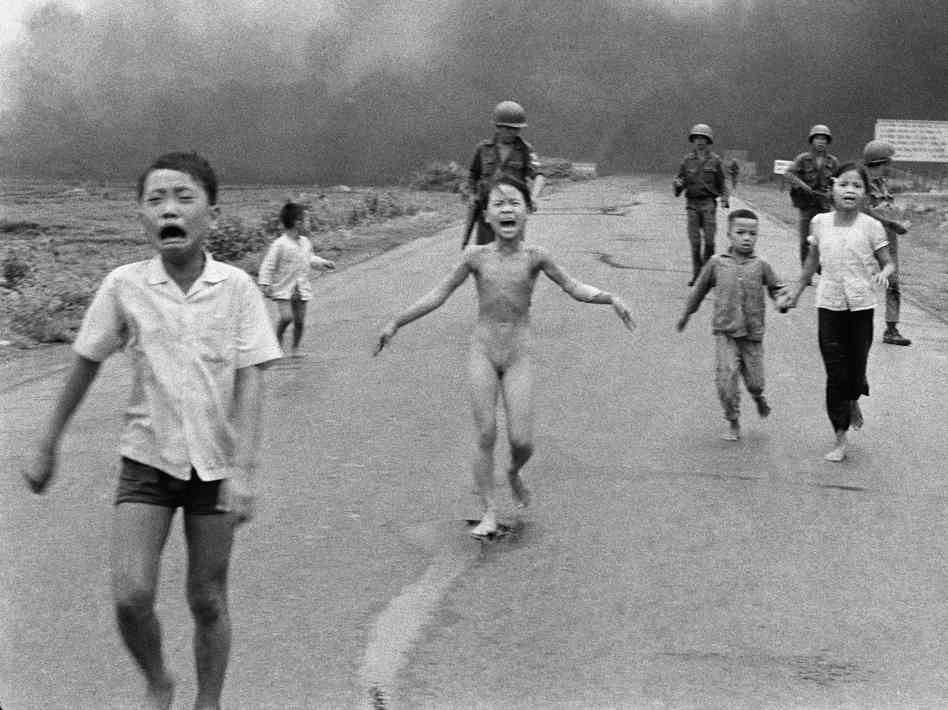
Napalm Girl Descriptive Paragraph

http://media.npr.org/assets/img/2012/06/03/napalm-girl-88f02cbaad205d1edf5f19e683c39e6cb4df9c3c-s6-c30.jpg

In this black-and-white photograph, five children can be seen running on a street towards the viewer of the photograph. All of them look quite malnourished and seem to be fleeing from something. The boy in the foreground on the left side of the picture has his eyes closed and his mouth wide open in a look of despair and immense fear. The girl in the middle of the picture is naked, running away with an expression of fear and distress on her face. A young boy and girl, following her on the right side of the picture, are holding hands as they run. The smallest of the children is following behind on the left side, slightly turning back towards the four soldiers following them. Unlike the children, the soldiers, who are loosely holding their guns, look fairly relaxed. Empty fields spread to each side of the slightly wet road and the thick smoke in the background covers the sky.

Kristina, Sandra, Markus

Donnerstag, 3. April 2014

History of Photography - Narrative

Version 1:The story of my life, the story of photography
There are dozens of people, dressed completely in black, who are watching me carefully. As soon as the coffin leaves the house, the descendants and acquaintances of my former owner start to discuss which of her many artistic possessions, meaning us, should now belong to whom. Had I been able to, I would probably have laughed in this situation for this is not the first or second time I am going to change owners and each and every time the same situation repeats itself. My constant change in owners, however, is only normal, as I was created in 1844. I can proudly say that I am the 170-year-old Daguerrotype of Louis Daguerre himself.
There are very few people in this world who know that the process needed for creating a Daguerrotype such as me is long and difficult. Photographs like me are taken through exposure of iodized silver plates to light. Those plates are insensitive to light, which leads to a long exposure time, and extremely expensive.  The worth of one plate is as much as that of fine jewellery. So back when I was created I was one of the most expensive possessions of my owner.
While people used to admire photographs such as me, they were also quite fearful of us, suspecting that the faces that resembled them so much could be watching them. Sadly, however, my whole life went through a change the day people realized that they could retouch negatives. Suddenly the mirrored image of their faces was not enough for them anymore, they wanted perfection. If their hair was not completely straight in a photograph they could just edit it later on. This, however, was not the worst of the inventions of photography that was yet to come. Clients even started to request reproductions of their photographs, created by a process that they called “mezzotint”. This process robbed images of their uniqueness and their famous “halo”, which gave our photographs that certain aura of prestige.
Though I am now worth several thousands of euros, the decline in taste when it comes to photography has deeply wounded me. People now make weird V-poses in front of these cameras that are apparently digital and can send them to everybody online. The fact that photographs like me remain though, has led to the revival of old photographs with hundreds of photographers trying to revive style of photography through which we were taken.

Feedback:My peers generally liked my text but mentioned that they could not find a conflict or goal in my story. They also mentioned that I used too much information and therefore did not concentrate enough on the narrative style of my story. So the advised me to use a bit less information and concentrate ind telling the photograph's story instead.

Final Version: The struggles in life of a 170-year-old Daguerrotype
As the first rays of light fall through the dusty windows, dozens of people, dressed completely in black, enter the tiny room and flock around the numerous pictures on the walls. Dust has settled on most photographs’ ebony frames. As soon as everybody has settled around the coffin, located in the middle of this stuffy room, the minute’s silence begins. Soon the silence is broken by quarrelling about who should inherit the many artistic possessions of my former owner. I watch the dispute with the inherent pride of a 170-year old Daguerrotype photograph. That is what I am: An original photograph of Daguerre himself, taken in 1844. Throughout the centuries I have changed owners many times and there is, as always, a single question on my mind: how will my new owner treat me?


My first owner, Daguerre, was the proud inventor of the camera obscura, the precursor of these tiny digital cameras the youth uses nowadays. Of course, when the first camera was invented, having your photo taken was an extremely long and expensive process. Back then iodized silver plates were used to create photographs, a single one of them worth as much as a fine piece of jewellery. Only the elite of society could therefore afford to have their photos taken. Those plates were also insensitive to light, leading to long exposure times. Daguerre therefore treated me with the utmost respect; handling me as though I was the most precious possession in his household, which I probably was.


I was later handed down to his ancestors and had to experience the decrease of prestige in photography. People started to leave their house when they had their pictures taken, returning with images that showed them with weird props in the background, which marked the beginning of studio photography. Worse, people had learned to reproduce photographs with a process called mezzotint, which led to the loss of the halo in photographs, an effect created by long exposure times. People had soon learned, however, to recreate this effect by using the gum print. Consequently, my worth decreased and each following owner handled me with less care.

My train of thought is interrupted by a hand grabbing me. “Mum, I want this one. This one is prettier than all the rest”. I want to smile. My life suddenly seems to go through a change once again.

Mittwoch, 2. April 2014

CAJ Rhetoric Analysis


In his argumentative text “Cyber War? Bring It On!” John C. Dvorak undermines the credibility of recent publications mentioning the imminent threat of cyber warfare by making several assumptions seem ridiculous.

The pathos in this argumentative text was only partly convincing, as the author mainly tried to establish his own credibility by undermining the credibility of other authors. Dvorak, for example, stated that none of the assumed cyber terrorists could possibly have the intention to start a cyberwar. This is either due to their close interaction with the “targets” of cyber attacks, or because they simply do not possess the means to start a cyber war.

Dvorak succeeds, however, in making good use of ethos in his article, as he takes on the role of a calming friend who refutes one by one, each claim that believers of the theory of an oncoming cyberwar make. What is even more important, he makes those claims look ridiculous in his readers’ eyes and therefore makes them feel embarrassed for having taken those claims seriously. The effect of this use of ethos is, that readers start to believe that the threat of cyberwar is nothing but simple “fear-mongering”.
The logos in this text is also well succeeded, as Dvorak logically links his ideas with each other and gives detailed explanations for each of his train of thoughts. He mentions, for example, that a similar situation of panic spreading within the population due to a computer programme already happened in the past and that this threat had turned out to be quite harmless. He even gives credit to the usefulness of the momentary situation, in saying that this new threat might lead to improved cyber security.
All in all, the article is quite convincing, though the author could have done a better job in convincing his reader by establishing himself as a more credible personality. 

Montag, 31. März 2014

Narrative Journalism: And Suddenly We Heard Gunshots

And Suddenly We Heard Gunshots

25-year-old Michael S., a missionary worker from South America, is sitting in his guest house in Kabul, playing cards with a friend of his, when suddenly someone starts screaming: “Three armed men”. As the first distant shots can be heard, his friend’s face grows pale. The sound of gunshots comes closer as they hide in the wardrobe of their room.

Two hours later, the police forces arrive and find Michael, his friend, as well as three other survivors of the attack in the guest house. The 25-year-old is shaking as he repeats the same words over and over again: “We are still alive”.

This is not the first attack on missionaries in Kabul, and it seems as though the bloody disputes are not going to come to an end soon. Even with a rising number of casualties every year, however, Roots of Peace resolve to help Kabul’s citizen does not waver.


Sonntag, 30. März 2014

Rhetoric in: Whoa, Dude, Are We Inside a Computer Right Now?

In his article “Whoa, Dude, Are We Inside a Computer Right Now?” Ben Makuch attempts to open his readers’ eyes to the possibility that the world we live in is nothing but a computer simulation.

In his argumentative article, Ben Makuch makes good use of logos, ethos and pathos and therefore achieves his goal of persuading his readers.

He first establishes the credibility of this theory in mentioning that “people like Nick Bostrom, the director of Oxford University’s Future of Humanity Institute, seriously consider“ this theory and in referring to credible sources such as Rich, “a well-regarded scientist, the director of the Center for Evolutionary Computation and Automated Design at NASA’s Jet Propulsion Laboratory
“. After mentioning these reputable sources, Ben Makuch further succeeds in establishing credibility by mentioning general laws, such as Moore’s Law, and by comparing technical findings to mathematical rules and physics.

He simultaneously appeals to the readers’ emotions in proposing that a Korean child could be controlling us right now and in consequently stirring our feelings of fear and panic that this could be the case. Already in the title of his article “Whoa, Dude, are we inside a computer right now?” he starts to build a relationship with his readers and takes on the role of one of their friends, who is just as curious and excited about this idea as we are. By mentioning that “every college student with a gravity bong and The Matrix on DVD“ has had the same idea before, he turns the ideas mentioned in his article into our ideas and makes his readers believe that they already thought like him before.

Makuch’s use of logos is shown in the various examples given for why it would be possible for us to be living inside a computer simulation right now. He first lets his readers know that this theory is not a new one, but has in fact been “kicked around for centuries“. Makuch continues by explaining that according to Moore’s Law computing power doubles every two years and that it will therefore be possible to create a computer simulation of the world we live in right now at some point. Last, but not least, he cites the the observable pixelation of the tiniest matter and the eerie similarities between quantum mechanics, showing how much our world resembles a computer simulation.  

In sum, the author makes perfect use of rhetoric, logos, ethos and pathos, and succeeds in making his article credible, personal and logical.


Famous Cyber Attacks: #1 Stuxnet

In the next few blog posts I would like to introduce a whole new aspect of my CAJ topic: Famous Cyber attacks. With the number of cyber attacks increasing annually, Pentagon has decided to consider cyber attacks acts of war. There are a number of those attacks out there that have become extremely popular; one of them being Stuxnet.


Stuxnet is frequently referred to as the world’s first cyber weapon. The malware, also known as a worm, was first discovered in June 2010 by a computer security firm in Belarus on the computer of one of their Iranian clients. What shocked computer specialists most about Stuxnet was the fact that this piece of malware could control things in the physical, real world. While it is still unclear who created the Stuxnet virus and what exactly the worm was targeting, it is well known that Stuxnet could even make whole motos blow up. The whole program was designed to sabotage and attack control system and consequently allow sabotage in pipelines, nuclear plants and other facilities.

Ever since the first computer was reported to have been infested with the Stuxnet virus, the worm has spread to more than 100.000 machines in 155 countries, though most infections are reported to have taken place in Iran. This explains why the suspected target of the Stuxnet virus is Iran. The worm first spread via an infected usb flash drive and later searches for vulnerable computers on the network in order to keep spreading.

Computer and control system security professionals like Ralph Langner, like many others, suspects that the main target of the Stuxnet attack were one of Iran’s nuclear power plants and an uranium enrichment facility located in the same country. The owners of these facilities, however, refuse to admit that the virus took control over their plants and there is likewise no nation that admits to having created Stuxnet, though the main suspects for this task are Israel and the U.S.A.

What is even more dangerous now than the Stuxnet virus itself is the fact that this functioning piece of malware was released on the internet and is now available for hackers to be further developed.